

THE ELDER
During her residency, Lua Rivera developed a body of work grounded in field research, using the snake as a central motif. In Paiwan culture, the hundred-pacer viper symbolizes ancestral spirits, honor, and protection. In Han cultural contexts, the snake is also referred to as a "little dragon" and is regarded as part of the celestial guardians accompanying the Lord of the Land (Tudi Gong), symbolizing auspiciousness, fortune, and the spiritual vitality of the land within folk belief.
Lua Rivera repositions the snake within the natural landscape of Taimali, allowing art and land to interweave and resonate with one another. As the serpentine form extends and winds through the terrain, the earth appears to regenerate traces of edible vegetation and life, symbolizing the continuity and renewal of local cultures, as well as the long-cultivated emotional connections between people and the land. Their inclusion situates the work within a specific ecological and cultural context, where the sacred and the ordinary remain intertwined.
Enlarged beyond human scale, the viper inscribes herself onto the land. Her body becomes both presence and terrain—a mark that is not imposed, but grown. In this gesture, she appears not only as animal, but as the deity she has long been understood to be.
This installation and its construction methods are original artistic expressions developed by Lua Rivera as part of the Rivera Rhizomatic Construction Method.
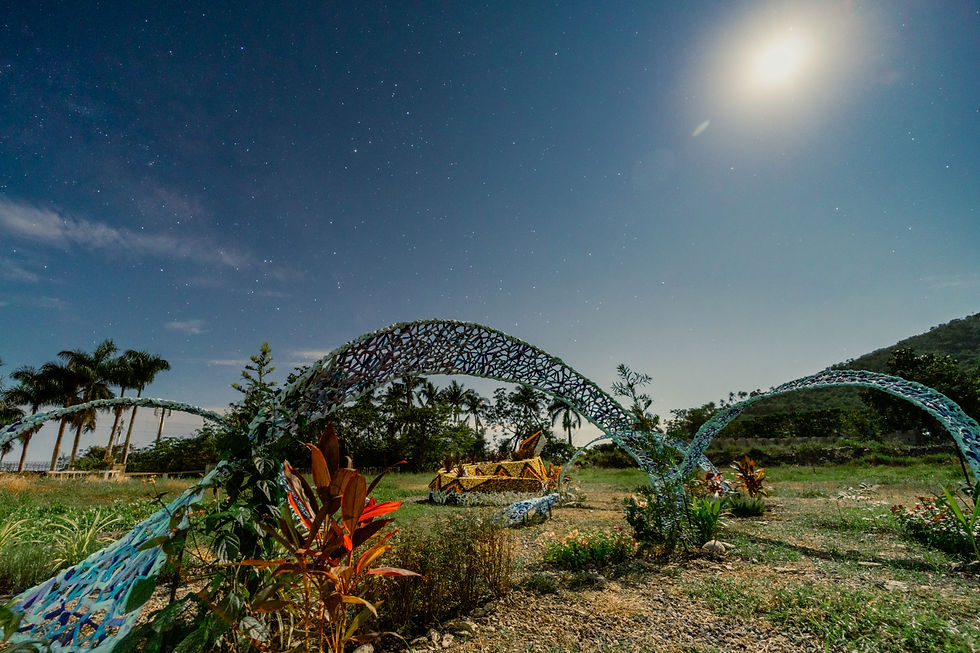


The Elder
2026.
Surplus textile material by Yee Chain, metal and plants.
20m (L) x 9m (W) x 2.2m (H)
Taimali, Taitung County, Taiwan.
South Link Arts Festival 2026